
Does Decarbing Smell? The Science Behind Cannabis Odor and How to Control It
Decarboxylation is the controlled heating process that converts inactive cannabinoid acids, such as THCA, into active THC. Without this chemical reaction, cannabis will not produce its intended psychoactive or therapeutic effects when used in edibles, tinctures, or infused products.
However, heating cannabis does more than activate cannabinoids; it also releases volatile aromatic compounds into the air. In a peer-reviewed study published in ACS Omega, researchers identified a previously unknown family of prenylated volatile sulfur compounds (VSCs) responsible for cannabis’ characteristic “skunk-like” aroma. The compound 3-methyl-2-butene-1-thiol (VSC3) was found to correlate most strongly with pungency levels across cultivars and to volatilize rapidly under heat exposure.
Because decarboxylation requires sustained heating, it accelerates the release of these sulfur-based odor compounds into the surrounding environment. This is why odor control becomes an important consideration when selecting the decarboxylation method you use, especially in enclosed or shared indoor spaces.
So, does decarbing smell? Yes. But the intensity, duration, and diffusion of that smell depend heavily on temperature control, airflow management, material quantity, and processing technique. Below is a structured, science-backed explanation of why it happens and how to manage it effectively.
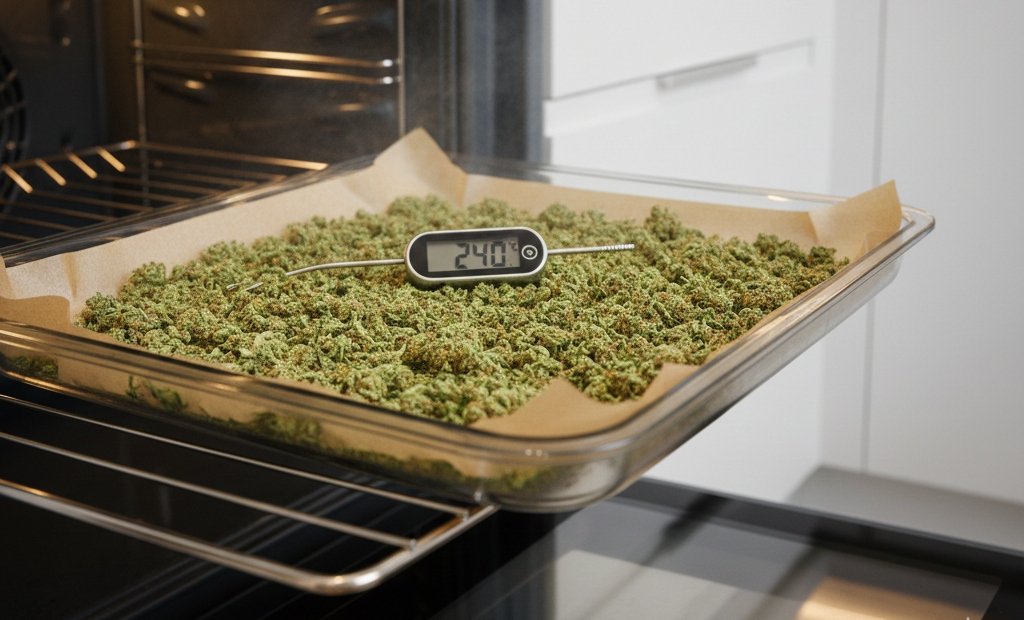
Does Decarbing Smell? Here’s What Actually Happens When You Heat Cannabis
Yes, decarbing cannabis produces a strong and noticeable odor. The smell is typically described as earthy, herbal, skunky, or slightly sulfur-like, similar to freshly cured flower or active smoking.
But the reason goes deeper than just “heating weed.”
Why Heating Cannabis Releases Strong Odors
When cannabis is heated between 220°F and 245°F (104°C–118°C) during decarboxylation, two primary chemical processes occur:
THCA converts into THC (activation process)
Volatile aromatic compounds are released into the air
These aromatic compounds include:
Terpenes
Volatile organic compounds (VOCs)
Trace sulfur-containing compounds
Sulfur-based molecules are especially important in odor perception. Research published in Talanta (San-Juan et al., 2012) identified 3-methyl-2-butene-1-thiol (3-MBT) as a highly potent odorant described as “marijuana, rubber, beer-like.”
The study determined that this compound has an odor threshold of just 0.5-1 nanogram per liter, meaning even microscopic amounts can be detected by the human nose. This explains why decarbing smells intense even when using small quantities of cannabis.
As temperature increases, aromatic compounds become more volatile, meaning they transition into the air more readily and at higher concentrations. That is why decarbing often smells stronger than simply storing cannabis at room temperature.
Why the Smell Feels Stronger Than Expected
Many people underestimate how powerful sulfur-containing odorants are. Compounds like thiols:
Have extremely low sensory thresholds
Bind strongly to human olfactory receptors
Are detectable long before visible smoke appears
Because decarboxylation occurs over 30-60 minutes of sustained heating, these molecules are released gradually and continuously. Unlike smoking (which produces a short, intense burst), decarbing allows odor compounds to accumulate in indoor air. Ventilation and room volume significantly affect perceived intensity.
How Long Does the Smell Last? Odor persistence depends largely on:
Room size
Ventilation quality
Air circulation
Temperature precision
Duration of heating
In poorly ventilated environments, the smell can linger for several hours. In spaces with proper airflow, it may dissipate within 1-3 hours after heating stops.
Longer heating times and higher temperatures increase compound release, intensifying and prolonging odor presence.
For temperature control guidance, review the methods you use when learning how to decarb cannabis effectively.
Is the decarbing smell stronger than smoking?
Decarbing often smells stronger over time because it releases aromatic compounds steadily for 30-60 minutes without combustion. Smoking produces sharper but shorter-lived odor bursts, while decarbing allows volatile compounds to continuously accumulate indoors.
What Factors Affect How Strong Decarbing Smells?
The intensity of odor during decarboxylation is not fixed. It varies depending on several environmental and procedural variables. Because decarbing involves sustained heating, small changes in setup can significantly influence how noticeable the smell becomes indoors.
Understanding these factors allows better control over odor concentration and indoor air impact.
Quantity of Cannabis Used
The amount of cannabis being decarbed directly affects odor intensity. Larger batches contain higher concentrations of terpenes and volatile sulfur compounds, which become airborne during heating.
As plant material volume increases, the total number of aromatic molecules released into the air also rises. Even modest increases in quantity can noticeably change room saturation levels. In smaller spaces, this effect becomes amplified due to limited air dilution capacity.
Larger quantities naturally release more aromatic compounds during heating, which increases overall odor intensity in enclosed spaces.
Temperature and Duration of Heating
Temperature plays a critical role in odor strength. As heat increases, molecular volatility rises, allowing terpenes and sulfur-containing compounds to evaporate more rapidly.
Maintaining recommended decarb temperatures (typically 220°F–245°F / 104°C–118°C) ensures efficient cannabinoid activation while minimizing excessive terpene degradation.
Controlled heating helps:
Activate cannabinoids effectively
Preserve terpene integrity
Limit unnecessary odor amplification
When temperatures exceed optimal ranges, volatility accelerates sharply. This not only increases smell intensity but may also degrade cannabinoid quality and alter aroma profiles.
Similarly, prolonged heating extends the duration of compound release, allowing odor molecules to accumulate in enclosed environments.
Ventilation and Airflow Conditions
Air exchange rate is one of the most influential factors in odor perception. In well-ventilated environments, volatile compounds disperse more quickly, reducing indoor concentration levels.
In poorly ventilated rooms, however, aromatic molecules accumulate and remain suspended in the air. Over time, this buildup increases perceived odor strength and persistence.
Airflow direction, open windows, exhaust systems, and room volume all determine how rapidly airborne compounds are diluted.
Does humidity affect cannabis odor indoors?
Yes. Higher humidity can slow molecular dispersion and encourage odor compounds to adhere to surfaces such as fabrics and walls. This can make the smell linger longer and feel more intense, even after heating has stopped.
Why Cannabis Odor Intensifies During Heating
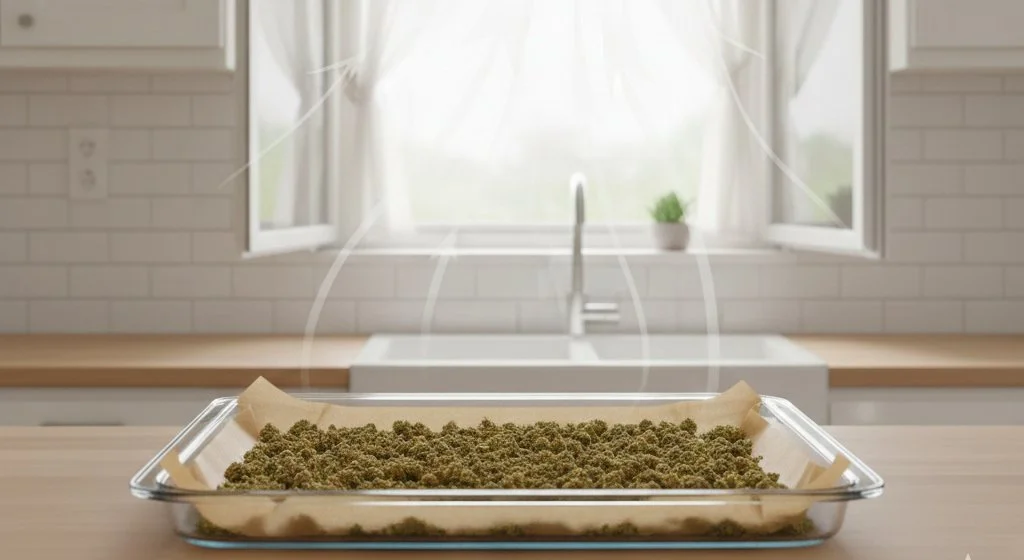
When cannabis is heated during decarboxylation, its chemical structure begins to change, and so does its aroma. Heat increases molecular activity, causing aromatic compounds to move from the plant material into the surrounding air. This rapid transition is what makes decarbing noticeably smell stronger than simple storage.
Terpenes Evaporate Quickly Under Heat
Terpenes are the aromatic compounds responsible for earthy, citrus, pine, or spicy strain profiles. During heating, these compounds volatilize, meaning they convert into vapor more rapidly.
As temperature rises within the typical decarb range (220–245°F), terpene evaporation accelerates. The faster they evaporate, the stronger the scent becomes in enclosed spaces.
Sulfur Compounds Intensify “Skunky” Notes
Certain sulfur-based compounds naturally present in cannabis have extremely low odor detection thresholds. Even in very small amounts, they can create strong skunky or rubber-like aromas.
When heat is applied, these compounds are released into the air more efficiently, which amplifies their sensory impact.
Heat Increases Airborne Diffusion
Heated air expands and circulates more rapidly, accelerating the diffusion of odor-active molecules throughout the room. As cannabis heats, odor molecules disperse more efficiently throughout the room. In spaces with limited ventilation, this leads to noticeable buildup and a stronger overall smell.
Temperature control plays a key role in balancing activation and odor management.
Does higher temperature always mean a stronger smell?
In most cases, yes. Higher temperatures increase compound volatility, which strengthens aroma release. However, overheating can degrade cannabinoids and terpenes, reducing quality while unnecessarily intensifying odor. Controlled heating is the most effective way to manage both potency and smell.
How to Reduce Cannabis Odor During Decarboxylation
Odor control during decarbing works through three mechanisms: dilution (ventilation), adsorption (charcoal), and containment (sealed heating). Combining these strategies produces significantly better results than using a single method alone.
Maximize Air Exchange to Dilute Airborne Odor Molecules
Proper ventilation reduces the concentration of volatile compounds released during heating. Opening windows on opposite sides of the room creates cross-ventilation, allowing fresh air to replace odor-heavy air continuously. Kitchen exhaust systems remove odor directly at the source. Without airflow, odor molecules accumulate and intensify indoors.
Use Activated Charcoal to Adsorb Volatile Odor Compounds
Activated charcoal traps odor molecules through adsorption, binding them to its porous carbon surface. Studies on treated charcoal demonstrate enhanced deodorization performance due to optimized pore structure and surface chemistry. This mechanism explains why carbon filters effectively capture airborne cannabis volatiles. Positioning charcoal close to the heat source improves performance.
Control Odor at the Source with Sealed Decarboxylation Methods
Containment prevents large volumes of aromatic compounds from escaping into the room. Using a tightly sealed, oven-safe glass container limits the release of terpenes and sulfur compounds into indoor air. Managing odor at the source is significantly more efficient than attempting to neutralize it after dispersion. Proper sealing substantially reduces overall smell intensity.
Does baking soda eliminate cannabis smell?
Baking soda may reduce mild lingering odors after decarbing, but it does not fully eliminate strong smells during active heating. Ventilation and activated charcoal remain the most effective odor control strategies.
Low-Odor Alternatives to Oven Decarbing
Traditional oven decarboxylation exposes cannabis directly to circulating air, allowing volatile compounds to disperse into the room. Low-odor alternatives focus on sealed heating environments, which significantly reduce the airborne release of terpenes and sulfur-based aroma compounds. These methods prioritize containment and temperature precision.
Sous-Vide Decarboxylation: Precision Heating in a Sealed System
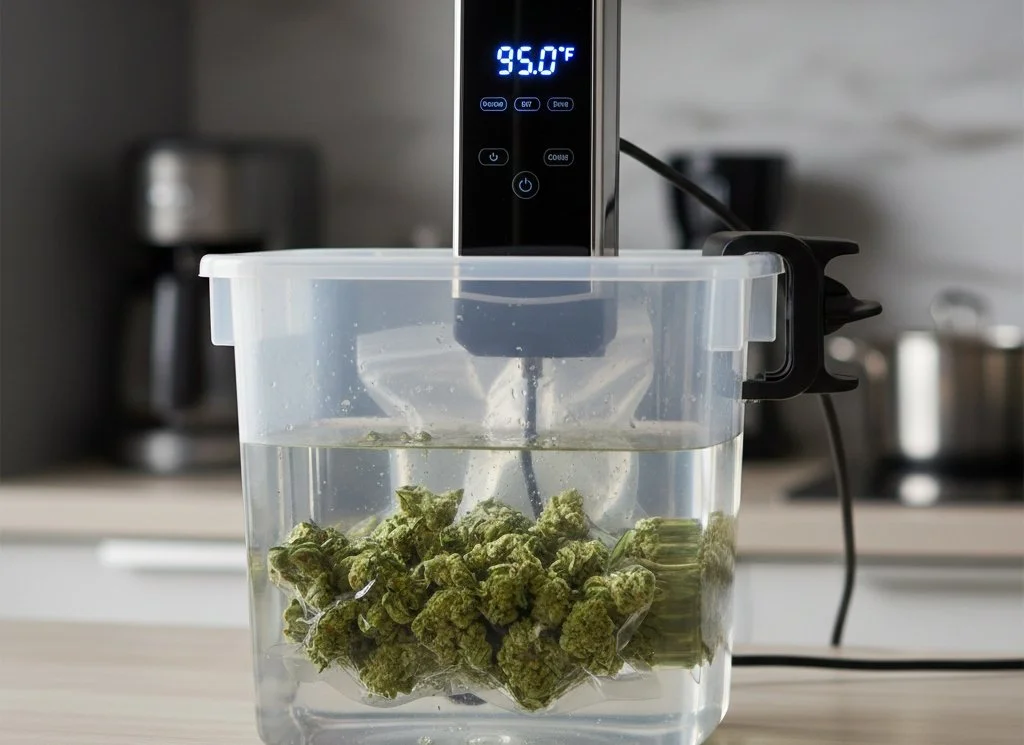
Sous-vide decarbing uses a vacuum-sealed bag submerged in a precisely controlled water bath. Because the cannabis remains sealed throughout the heating process, volatile compounds are largely contained within the bag rather than released into the surrounding air.
This method offers exceptional temperature stability, reducing the risk of overheating and unnecessary terpene degradation. In addition to minimizing odor, it supports better cannabinoid activation consistency.
The primary limitation is practicality; an immersion circulator and vacuum sealer are required, and the process typically takes longer than standard oven decarbing.
Enclosed Decarboxylation Devices: Controlled, Contained Processing
Dedicated decarboxylation machines are designed to heat cannabis in a sealed internal chamber. By limiting exposure to open air, they substantially reduce odor spread compared to conventional ovens.
These systems also improve thermal consistency, helping maintain uniform cannabinoid conversion across batches. For cannabis brands preparing material for infused products such as kief-infused joints, controlled environments support both product consistency and reduced environmental odor impact.
While not completely odorless, enclosed devices dramatically lower detectable smell in indoor settings.
Are enclosed decarb devices completely odorless?
No decarboxylation method is entirely odor-free. However, sealed systems significantly reduce airborne odor compared to open oven heating by containing volatile compounds during activation.
Does Decarbing Smell in Apartments or Shared Spaces?
Yes, odor tends to be more noticeable and longer-lasting in apartments or shared living environments. Limited ventilation, confined square footage, and shared airflow systems can allow volatile cannabis compounds to accumulate rather than dissipate quickly.
Limited Air Exchange in Compact Living Spaces
Apartments typically have reduced air circulation compared to standalone homes. Smaller rooms, restricted cross-ventilation, and centralized HVAC systems can slow the dilution of airborne terpenes and other odor-active compounds.
In some buildings, shared ventilation pathways may allow smell to travel beyond the immediate unit. When fresh air exchange is low, odor molecules remain suspended longer, increasing overall intensity.
Odor Absorption by Soft and Porous Surfaces
Terpenes and other volatile compounds can temporarily adsorb onto fabrics, curtains, carpets, and upholstered furniture. While this absorption is not permanent, it can extend how long the smell is perceived indoors.
Soft materials act as short-term reservoirs, slowly re-releasing odor molecules back into the air over time. Maintaining airflow and using adsorbents such as activated charcoal can reduce lingering effects.
How can you quickly clear the decarb smell?
Immediately increase ventilation by opening windows and creating cross-breeze airflow. Use activated charcoal or carbon-based air purifiers to adsorb odor molecules. Avoid overheating cannabis, as higher temperatures increase volatile release and intensify indoor smell.
From Decarb to Infusion: Build a More Controlled Cannabis Workflow
Decarboxylation is a chemistry-driven process. When temperature, airflow, and containment are controlled, odor becomes predictable and manageable instead of disruptive. The same principle applies in licensed production environments, where consistency and environmental control directly impact product quality and operational efficiency.
For cannabis brands working with decarbed concentrates for infused pre-rolls, maintaining temperature precision and controlled material handling is critical beyond the activation stage. Systems like Jiko from Sorting Robotics are designed to handle decarbed concentrates with repeatable accuracy, helping manufacturers reduce material waste, improve dosing consistency, and streamline production workflows.
If you’re scaling infused product manufacturing and need tighter control across your post-decarb processes, schedule a demo with Sorting Robotics to see how Jiko integrates into a controlled production environment.
Visit SortingRobotics.com or call +1 (747) 298-7429 to learn more!
Frequently Asked Questions
How strong does decarbing smell compared to smoking?
Decarbing typically produces a steady, sustained odor over 30–60 minutes, while smoking creates a sharper but shorter burst. The overall intensity can feel stronger during decarbing because the release is continuous.
How long does decarb smell stay in a room?
In poorly ventilated spaces, odor can linger for several hours. With proper airflow and adsorption (e.g., activated carbon), the smell often dissipates within 1-3 hours.
Does lowering the temperature reduce smell?
Yes. Staying within recommended decarb ranges (typically 220-245°F / 104-118°C) limits excessive terpene volatilization while still activating cannabinoids efficiently.
Can air purifiers eliminate cannabis odor?
High-quality purifiers with activated carbon filters significantly reduce airborne odor molecules. However, no system guarantees 100% elimination during active heating.
Is it possible to decarb with almost no smell?
Nearly odor-minimized methods, such as vacuum-sealed sous-vide or enclosed decarb devices, can dramatically reduce smell, but trace aroma release may still occur when opening containers after heating.